THE PILATES DEBATE
THE DIFFERENCE BETWEEN CLASSICAL, CONTEMPORARY AND PILATES FITNESS.
The original system. Built for how your body actually moves.
Classical Pilates is the complete, integrated method developed by Joseph Pilates in the early twentieth century. Before the work was splintered into modern fitness trends, it was designed as a cohesive physical and nervous system practice: a specific sequence of exercises performed on specialized apparatus with deliberate spring resistance, rhythm, and breath.
At Ritual Form, we teach the classical repertoire as a living framework. Rather than chasing muscle burn or rigid aesthetics, we use the traditional system to build structural integrity, deep coordination, and lasting body agency.
THE RITUAL FORM APPROACH
-
We train exclusively on authentic Gratz apparatus, engineered to Joseph Pilates' exact dimensions and spring tensions. The equipment does not just add resistance. It provides clear tactile feedback that guides your alignment and teaches your nervous system how to organize effort efficiently.
-
Every piece of equipment in the studio (Reformer, Cadillac, Wunda Chair, Tower, and Barrels) is part of one interconnected vocabulary. Skills you build on the mat inform how you move on the Reformer, and discoveries on the Chair unlock stability on the Cadillac.
-
We prioritize how a movement feels from the inside out. By slowing down and tuning into breath, joint mechanics, and subtle muscular recruitment, you learn to move with less unnecessary tension and greater power.
-
Our studios are strictly phone-free environments. Stepping away from screens allows you to drop out of performative habits and focus entirely on your own physical experience.
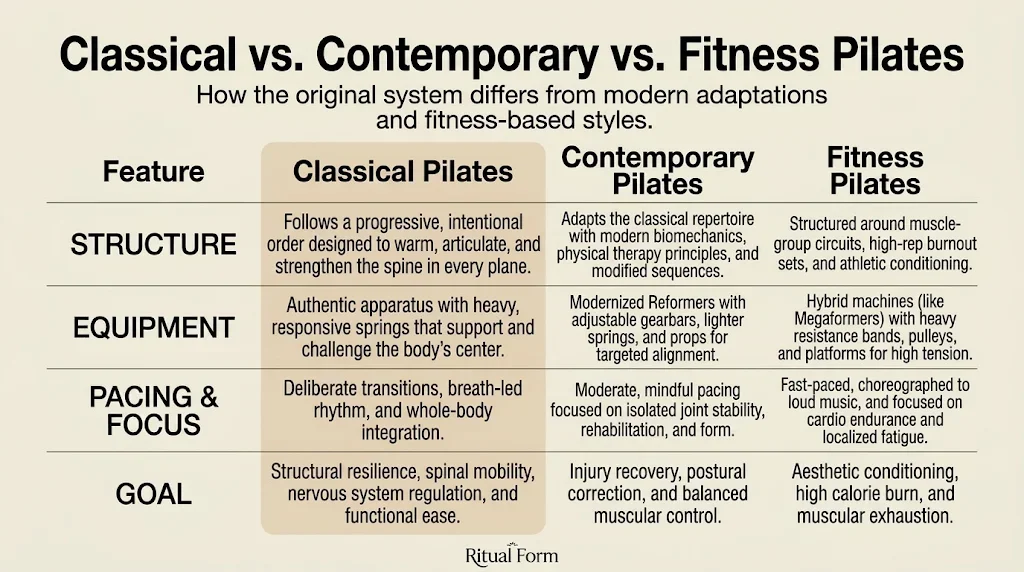
Classical vs. Contemporary Pilates vs. Fitness pilates
While contemporary styles often isolate muscle groups or borrow movements from gym workouts, Classical Pilates trains the body as a single integrated unit.